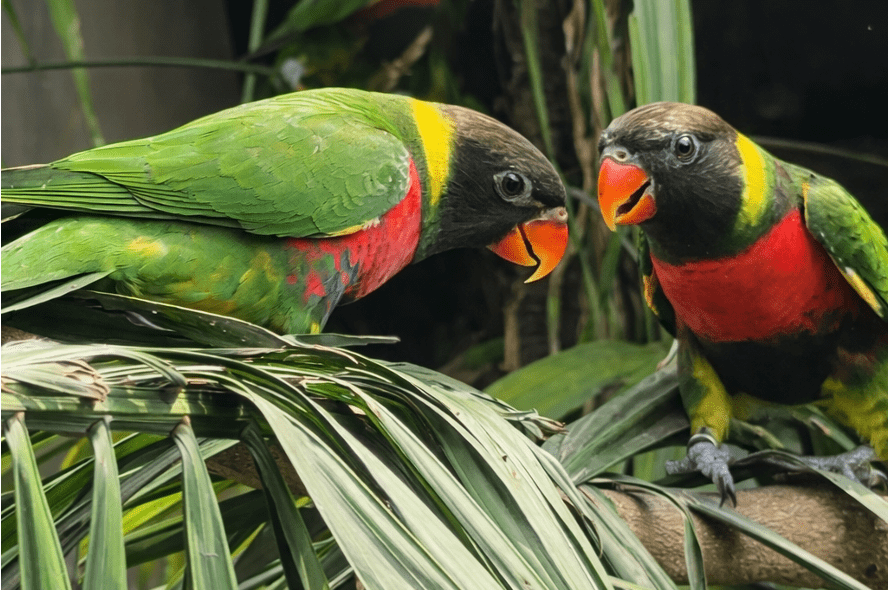
Mitchell’s Lorikeet is one of the bird species included in Bali Bird Park’s conservation breeding programme. Also known as Perkici Dada Merah and locally as Atat Bali, this species is an important part of Indonesia’s biodiversity. At Bali Bird Park, its conservation involves professional care, responsible breeding, and visitor education.
For those interested in Mitchell’s Lorikeet, learning about the species also provides an opportunity to understand the importance of protecting native Indonesian birds. The species is endemic to Bali and Lombok, making its conservation especially meaningful within Indonesia’s natural heritage.
The Mitchell’s Lorikeet breeding programme forms part of Bali Bird Park’s Fighting Extinction commitment. The avian team provides professional care throughout the breeding process, with attention to the birds’ biological needs, health, nutrition, and pair management.
Mitchell’s Lorikeet and Indonesia’s Biodiversity
Mitchell’s Lorikeet, or Perkici Dada Merah, is an endemic species of Bali and Lombok. As a native bird, it forms an important part of Indonesia’s biodiversity.
Protecting native species requires long-term care and dedicated conservation efforts. Therefore, programmes that focus on responsible animal care can play an important role in supporting the future of these birds.
For visitors, learning about a species such as the Mitchell’s Lorikeet can also create a stronger connection with Indonesia’s wildlife. Rather than seeing birds only as part of a collection, visitors can discover why individual species matter and why their conservation is important.
This makes a visit to Bali Bird Park more than a wildlife experience. It can also be an opportunity to learn about native birds and the role that conservation institutions can play in supporting biodiversity.
Conservation Breeding for Mitchell’s Lorikeet
Conservation breeding is an important part of the work involving Mitchell’s Lorikeet at Bali Bird Park. However, breeding is not simply about producing new individuals.
Each stage requires careful monitoring and responsible animal care. Bird welfare remains a priority throughout the process.

As a result, a conservation breeding programme requires patience, knowledge, and consistent attention. The birds’ needs must be considered throughout the breeding process, while their health and wellbeing remain central to the programme.
This approach highlights an important part of wildlife conservation in Bali. Successful conservation is not achieved through one action alone. Instead, it involves ongoing care and a clear commitment to supporting species over the long term.
Professional Care for the Breeding Programme
The avian team at Bali Bird Park provides professional care for the Mitchell’s Lorikeet breeding programme. Their approach considers several important areas, including biological needs, health, nutrition, and pair management.
First, understanding biological needs helps ensure that care is appropriate for the species. Next, health monitoring supports the wellbeing of the birds. Nutrition is also an important part of responsible animal care, while pair management is considered throughout the breeding process.
Together, these areas form part of a careful approach to conservation breeding. Moreover, they demonstrate why professional knowledge is important when working with birds in a conservation programme.
The focus on bird welfare also reinforces the role of Bali Bird Park as a Conservation Institution. The programme combines responsible breeding with animal care and education to support biodiversity.
Learning About Perkici Dada Merah
Conservation is not only about the work carried out behind the scenes. Education is another important part of helping people understand wildlife.
The Mitchell’s Lorikeet programme provides an opportunity for visitors to learn about Perkici Dada Merah, or Atat Bali. Visitors can discover more about the species, its characteristics, and the importance of protecting Indonesia’s native birds.
For children and families, this can make a wildlife visit more meaningful. Seeing birds in person can encourage curiosity, while learning about conservation can help visitors understand why protecting biodiversity matters.
Furthermore, education can help connect visitors with conservation action. When people understand the needs of wildlife, they may become more aware of the importance of responsible care and habitat protection.
Fighting Extinction at Bali Bird Park
The Mitchell’s Lorikeet breeding programme is part of Bali Bird Park’s Fighting Extinction commitment. This programme reflects the park’s wider role in supporting bird conservation through responsible breeding, animal care, and education.
Fighting Extinction is therefore about more than a single breeding programme. It represents a long-term approach to conservation, where professional care and education work together.
In addition, the programme helps demonstrate that conservation requires collaboration and dedication. Every stage of the breeding process needs careful attention, while bird welfare remains a priority.
By sharing this work with visitors, Bali Bird Park can also help create greater awareness of Indonesia’s native bird species.
Supporting Indonesia’s Biodiversity
Indonesia is home to a rich variety of wildlife, including many native bird species. Protecting this biodiversity requires continued care and responsible conservation efforts.
Mitchell’s Lorikeet is one example of a species that forms part of this natural heritage. Because the species is endemic to Bali and Lombok, its conservation has a strong connection to the biodiversity of these islands.
For this reason, conservation breeding can provide an important opportunity to support the future of individual bird species. At the same time, education can help visitors understand why biodiversity deserves protection.
Bali Bird Park brings these elements together through its work as a Conservation Institution. The Mitchell’s Lorikeet programme shows how responsible breeding, professional animal care, and education can work alongside one another.
Discover Mitchell’s Lorikeet at Bali Bird Park
The Mitchell’s Lorikeet, also known as Perkici Dada Merah or Atat Bali, is an important part of Bali Bird Park’s conservation breeding programme. Its conservation involves careful animal care, health and nutrition management, pair management, and a strong focus on bird welfare.
Moreover, the programme provides an opportunity for visitors to learn about one of Indonesia’s native bird species and understand why conservation matters.
So, when visiting Bali Bird Park, take the opportunity to discover more about Mitchell’s Lorikeet and the work behind its conservation breeding programme. Learn how the park’s Fighting Extinction commitment brings together education, responsible animal care, and conservation to support Indonesia’s native birds.