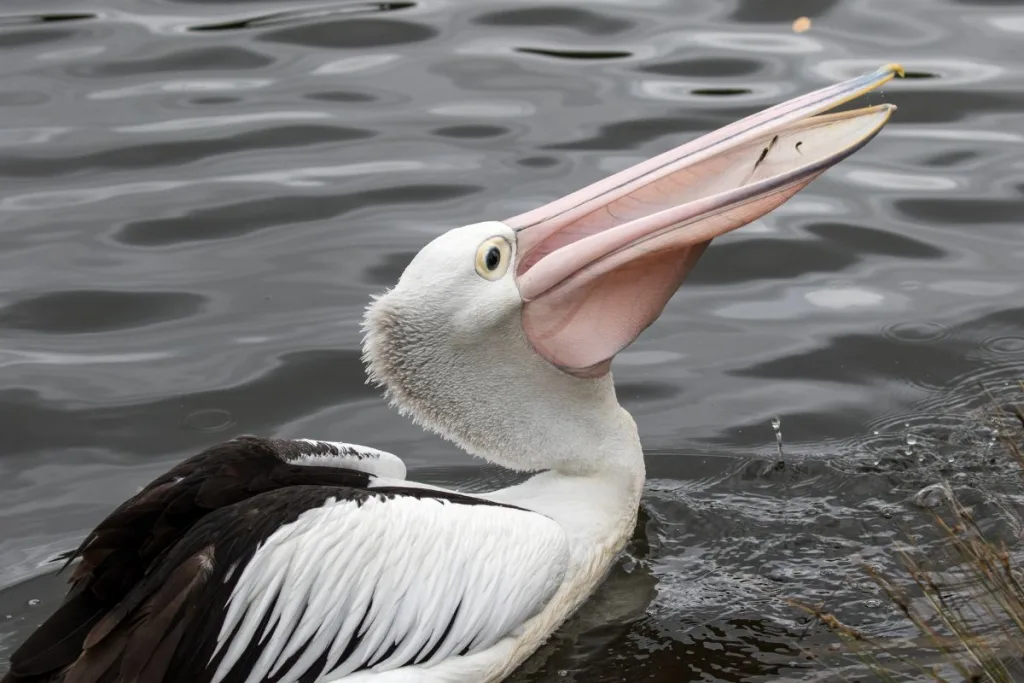
When you see an Australian pelican, the first thing that captures your attention is its enormous pink bill. It is the longest bill of any living bird, reaching around 40 to 50 centimeters.
This impressive waterbird, with its calm expression and striking black-and-white plumage, is one of the most remarkable sights in nature.
The Australian pelican moves gracefully across both land and water. It glides above lakes and coastlines with quiet power, its vast wings cutting through the sky. Watching it land on still water feels like witnessing balance itself.
Among waterbirds, few species can compare. This bird is built for survival, perfectly adapted to Australia’s unpredictable environments. And when you see one up close, like at Bali Bird Park, you start to understand just how extraordinary they really are.
Appearance

The Australian Pelican’s size varies slightly between individuals, but its overall look remains unmistakable. This is a bird of balance and proportion. Its head is small compared to its large body, yet the enormous pink bill defines its entire silhouette.
Their feathers are sleek and mostly white, with jet-black wingtips and tails. These black feathers are visible even when folded, giving them a smart, sharply dressed appearance. When the bird takes flight, the contrast becomes more dramatic, with black and white stretching wide across the sky.
A typical Australian Pelican’s height is around 1.7 meters when standing upright. Their long legs and webbed feet make them perfect waders. Their eyes, surrounded by pale yellow skin, always seem calm and observant.
During breeding season, the bill and pouch of both males and females may deepen in color, becoming more vivid pink or orange. The Australian pelican female is usually a bit smaller than the male, with a slightly shorter bill, but both share the same graceful look.
Australian pelican wingspan can reach up to 2.5 meters, giving them incredible control in flight. They soar on thermal currents, conserving energy as they travel vast distances. This ability to glide for hours helps them survive in areas where water and food sources shift with the climate.
Habitat and Nomadic Lifestyle

The Australian Pelican habitat covers almost the entire continent. They are found in coastal areas, inland lakes, large rivers, estuaries, and even temporary floodwaters that appear after heavy rains.
Unlike many other pelicans, they are not limited to the ocean. They are equally at home in freshwater environments, provided there is enough open space to take off, land, and feed. This adaptability explains why you can find them everywhere, from tropical wetlands in the north to cool southern lakes.
Australian pelicans are also known for their nomadic behavior. They do not stay in one location for long. When inland lakes dry up, they travel hundreds or even thousands of kilometers to find new feeding grounds. When rains arrive, they return to inland areas where temporary lakes form and food becomes abundant.
They rely on air currents to travel long distances, often flying at high altitudes. Some individuals have been recorded at elevations of around 3,000 meters. This mobility helps them thrive in a country where water conditions change dramatically.
Their movements are driven by instinct and survival. It is as if they are guided by an invisible map of Australia’s shifting waterways, moving with precision and purpose.
Diet and Feeding Behavior

The diet of the Australian pelican is mainly composed of fish, but they are also opportunistic feeders. They will take amphibians, crustaceans, insects, and occasionally even small birds or carrion if necessary.
When it comes to feeding, cooperation is key. Pelicans often hunt in groups, forming a semicircle in shallow water to herd fish together. Then, in perfect timing, they dip their bills to scoop up fish along with water. Once lifted, they drain the water out, leaving the fish behind in the pouch.
This group feeding method increases their success rate. It also shows their intelligence and coordination. Watching a group of pelicans working together is like watching a team that has practiced for years.
Sometimes, they feed individually, standing still and waiting for fish to come close before striking. In coastal areas, they may also follow fishing boats, seizing leftover fish or scraps tossed overboard.
The feeding process is elegant. When they lift their bills, you can see droplets fall from the pouch as the fish slides down the throat. Despite their size, their movements are calm and precise.
Breeding and Nesting Habits

Breeding among Australian pelicans depends heavily on rainfall and water availability. They can breed at any time of the year when conditions are favorable, especially after inland flooding events that create large, isolated water bodies.
They are social birds and form large breeding colonies, sometimes numbering thousands of pairs. The nests are simple, shallow scrapes in the ground, usually built on islands or sandspits where predators cannot easily reach them.
Males collect materials like sticks and grass, while females shape the nest and stay to guard the site. Once the eggs are laid, both parents take turns incubating them for about 30 to 36 days.
A typical clutch contains two or three eggs. The chicks hatch covered in white down and depend entirely on their parents. Feeding is done directly from the parent’s bill, where the chick reaches in to take regurgitated fish.
When several chicks hatch in the same nest, competition can be intense. The firstborn is often stronger and may outcompete its siblings for food. In some cases, only one chick survives to fledging age.
As the chicks grow, they begin forming groups known as “creches.” Here, dozens or even hundreds of young pelicans stay together while parents return to feed them. Around 10 to 12 weeks later, they begin to fly and explore on their own.
This breeding strategy, built on cooperation and timing, ensures that enough chicks survive even in the unpredictable Australian climate.
Interesting Facts

Here are some facts that reveal more about this fascinating bird:
- Their bill is the longest of any living bird, reaching up to 50 centimeters.
- The throat pouch can hold several liters of water and prey. It also helps regulate body temperature.
- Their wingspan can reach 2.5 meters, giving them superb gliding ability.
- They can soar for hours using thermal air currents without much wing flapping.
- They are strong flyers and can travel thousands of kilometers between feeding and breeding sites.
- The species is not considered threatened and is listed as Least Concern on the IUCN Red List.
- They often gather in huge flocks, especially around temporary inland lakes after heavy rains.
Each of these traits shows how perfectly adapted they are to life in Australia’s ever-changing landscapes.
Up Close with Australian Pelicans at Bali Bird Park

The park’s staff also provides information about their habits, diet, and conservation. You will learn how pelicans adapt to different environments and why they play an important role in aquatic ecosystems.
Beyond being a popular destination, Bali Bird Park stands as a sanctuary devoted to learning and appreciation of the natural world. Every encounter encourages visitors to appreciate and protect the diversity of bird life in our region.
Being near such a large and gentle creature leaves a deep impression. You see how power and gentleness can coexist in perfect balance. It is an experience that stays with you long after you leave.
The Australian pelican stands out as one of the most remarkable birds in the world. With a bill built for distance and wings that seem to hold the horizon, it becomes a living image of strength and freedom.
From coastal shores to inland deserts, this bird continues to thrive across Australia’s landscapes. The way it thrives across great distances and among many others is proof of nature’s gift for blending beauty with purpose.
When you see them in person, whether in the wild or at Bali Bird Park, you understand why this species inspires admiration everywhere it goes. It is more than a waterbird. It embodies endurance and the serene power that binds life together in nature.