When people talk about owls, most imagine the classic “hoo-hoo” sound echoing in the night. But if you spend time in the tropical forests of Southeast Asia, you might meet a very different kind of owl. It’s called the buffy fish owl, and unlike many of its cousins, this bird doesn’t just live in the woods and hunt small rodents.
Instead, it has adapted to life near rivers, swamps, and lakes, turning the dark waters into its hunting ground. Mysterious, fierce, and fascinating, the buffy fish owl (Ketupa ketupu) is one of the most unique owl species in the world.
Introduction to Buffy Fish Owl

The buffy fish owl, also known by its scientific name Ketupa ketupu, belongs to the Strigidae family. Locals sometimes call it “burung hantu ikan” in Indonesia or “burung hantu padi” in Malaysia. Unlike barn owls or snowy owls, which prefer drier habitats, this species thrives in wetlands and forested riverbanks.
Its distribution stretches across much of Southeast Asia: Indonesia (Sumatra, Java, Borneo), Malaysia, Singapore, Thailand, Myanmar, Cambodia, Laos, and Vietnam. Within these regions, the buffy fish owl serves as a crucial predator, helping to balance ecosystems by controlling populations of fish, frogs, and small animals.
Physical Characteristics of the Buffy Fish Owl

Before talking about its habits, let’s start by picturing what this owl actually looks like.
Size and Appearance
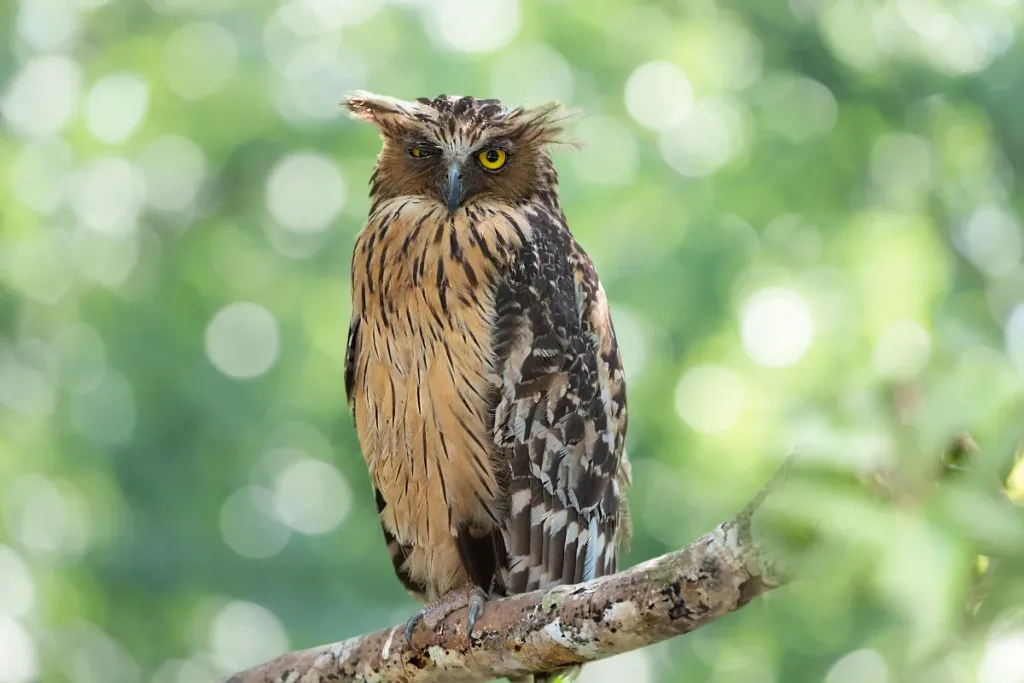
The buffy fish owl is a medium to large owl, measuring about 40–48 cm in length, with a wingspan that can reach nearly a meter. Its plumage is buff-brown with darker streaks, perfect for blending into forested habitats.
Unlike the soft, silent flight feathers of most owls, its wing feathers are less adapted for noiseless flight—an adaptation that suits its fishing lifestyle, where stealth in water hunting matters more than silence.
The most striking feature is its large, yellow eyes. They give the owl a fierce, almost hypnotic appearance, enabling it to detect the tiny movements of prey at night.
Distinctive Features
Unlike many owls that have a rounded facial disc, the buffy fish owl lacks this feature, giving its face a flatter appearance. Another distinctive trait is its long, pointed ear tufts, which rise like little horns when the bird is alert. These tufts aren’t ears but feathers, possibly used for communication or camouflage.
Habitat and Distribution

The buffy fish owl has a very specific choice of home compared to other owls.
Natural Habitat
This bird thrives in tropical forests, swamps, mangroves, and especially near rivers and lakes. It often roosts on branches hanging directly above the water, giving it the perfect vantage point for hunting. It can also adapt to secondary habitats such as aquaculture ponds, plantations, and even rural gardens, as long as water sources remain nearby.
Geographical Range
The owl’s range covers much of Southeast Asia:
- Indonesia: Sumatra, Java, Kalimantan, and surrounding islands.
- Malaysia: Peninsular Malaysia and Borneo.
- Thailand and Myanmar: Especially in the southern and forested regions.
- Singapore, Cambodia, Laos, Vietnam: Though rarer, still present in forest reserves and protected wetlands.
Its closest relative, the tawny fish owl (Ketupa flavipes), lives further north in the Himalayas, China, and northern Southeast Asia. While similar in behavior, the tawny fish owl is larger and inhabits cooler forests.
Behavior and Diet

The behavior of the buffy fish owl is just as fascinating as its appearance.
Hunting Habits
This owl is nocturnal. During the day, it perches quietly in trees, usually well camouflaged. At night, it becomes active, flying low along rivers or sitting silently above the water, waiting for prey.
Unlike other owls that rely heavily on hearing to detect rodents, this species uses its sharp eyesight to scan the water. Once it detects ripples, it swoops down and grabs prey with its strong talons. Sometimes, it even wades into shallow streams to catch frogs or crabs.
Diet
The buffy fish owl’s diet is mainly made up of fish, but it also eats frogs, crabs, insects, small reptiles, and even carrion. Its ability to hunt aquatic prey sets it apart from most owl species, which typically focus on mammals or birds.
Breeding and Lifecycle

The breeding season varies depending on location. In West Java, it usually takes place from February to April, while in Malaysia, it may occur between September and January.
Nests are built in tree hollows, rocky crevices, or abandoned nests of other birds. Sometimes, they even use unusual sites, such as ledges behind waterfalls. Females typically lay one egg, occasionally two. The incubation period lasts approximately 28–29 days, during which the female sits on the egg while the male provides food.
After hatching, chicks grow quickly and fledge within six weeks, though they may stay near their parents for longer as they learn to hunt.
Conservation Status

According to the IUCN Red List, the buffy fish owl is currently classified as Least Concern due to its wide distribution and stable population (IUCN).
However, the species faces several threats:
- Habitat loss: Wetlands and forests are being destroyed for agriculture, palm oil plantations, and development.
- Human disturbance: The expansion of urban areas and tourism disrupts nesting and feeding.
- Water pollution: Contaminated rivers and lakes reduce fish populations, directly affecting the owl’s food supply.
Although not endangered now, the owl’s future depends on protecting freshwater ecosystems across Southeast Asia.
Interesting Facts about the Buffy Fish Owl

- Calls: The buffy fish owl sound is very different from the soft hoots of barn owls. It makes loud rattling calls like “kutook,” “pof-pof-pof,” or even hawk-like screeches, often used in duets between pairs.
- Fishing skills: Few owls specialize in catching fish, making this species highly unique.
- Cultural ties: In some Southeast Asian traditions, the owl is associated with myths and spiritual beliefs, often regarded as a messenger from the unseen world.
- Adaptability: Although it prefers forests, it has demonstrated surprising resilience by inhabiting secondary habitats, such as aquaculture ponds.
See the Buffy Fish Owl at Bali Bird Park

If you’re curious to see this owl without venturing into the wild, visit Bali Bird Park in Indonesia. The park is home to hundreds of bird species, including the buffy fish owl. Here, visitors can observe its piercing eyes, unique ear tufts, and even listen to its unusual calls.
Beyond the owl, Bali Bird Park also features hornbills, cassowaries, birds of paradise, and many more. The park doubles as a conservation and education center, helping to raise awareness about Southeast Asia’s fragile bird populations.
The buffy fish owl is a remarkable bird, one of the few owls in the world that specializes in fishing. With its piercing yellow eyes, long ear tufts, and unique hunting methods, it stands apart from its relatives. From its range across Southeast Asia to its fascinating diet and eerie calls, this owl reminds us of the complexity and diversity of nature.
Although currently listed as Least Concern, the species faces growing threats from habitat loss and pollution. Protecting rivers, wetlands, and forests ensures not just the survival of fish and plants but also the continuation of this mysterious owl’s life in the wild.
If you ever get the chance, go and see it for yourself, whether in the wilderness or at Bali Bird Park. Once you’ve looked into its eyes, you’ll understand why the buffy fish owl is considered one of Southeast Asia’s most treasured bird species.