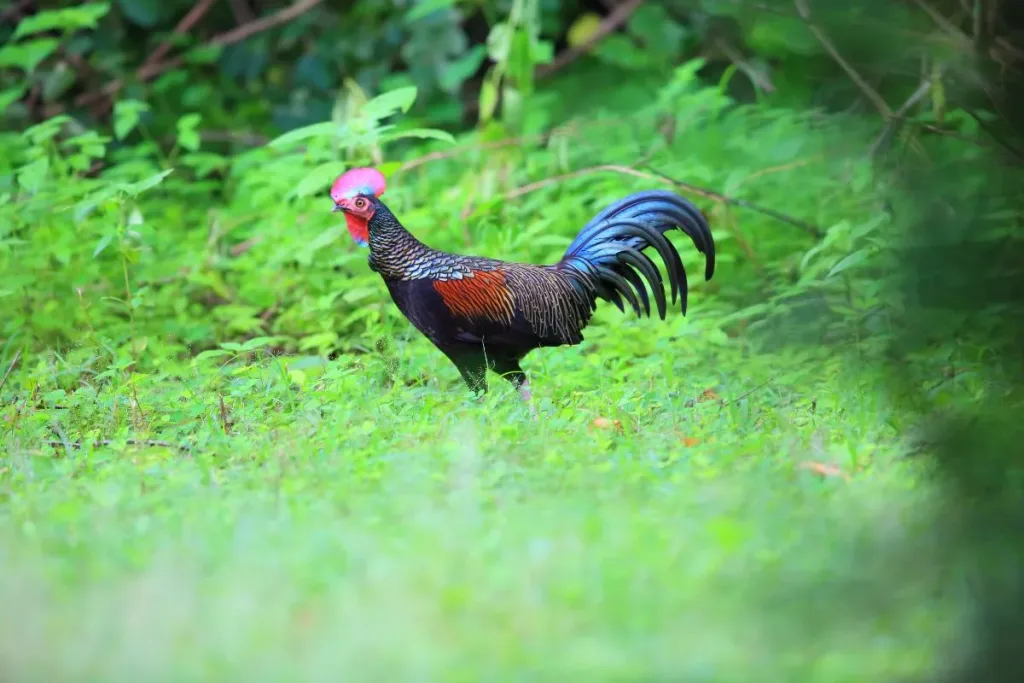
You’ve probably heard of the Red Junglefowl, the wild ancestor of all domestic chickens around the world. It’s famous, widespread, and easy to recognize. But Indonesia has something much rarer and even more dazzling, the Green Junglefowl.
This bird is like the Red Junglefowl’s equally stunning but far more exclusive cousin. Unlike its red-feathered relative that roams across Asia, the Green Junglefowl lives only in Indonesia. It’s one of those national treasures that quietly thrive in the country’s tropical islands.
Known for its glowing plumage and sharp metallic call, this bird stands as a living symbol of Indonesia’s wild beauty. In this article, you’ll explore its brilliant colors, secretive lifestyle, and special connection to local culture.
Physical Appearance

When a male Green Junglefowl steps into sunlight, its feathers light up like tropical gemstones. Each feather reflects shades of emerald, blue, bronze, and gold depending on how the light hits. These shimmering tones come from the structure of the feathers that bend light, not from pigment.
The male’s throat hackles are bright and metallic violet, fading into blue and green as they move toward the chest. Its comb is unlike any other, icy blue at the base, blending into purplish-red near the tips. The wattles have a similar mix of blue, purple, and yellow tones, making this bird a true masterpiece of nature.
Its long, curved tail feathers give a graceful shape when it walks or performs courtship displays. The male can reach up to 75 centimeters in length, giving it a proud and elegant presence.
The female, on the other hand, is more reserved in color and size. Her plumage is brown and olive, patterned for camouflage among dry leaves and branches. She lacks the male’s bright comb and iridescent glow, but her subtle tones help her stay hidden from predators.
The contrast between male and female shows how perfectly adapted this species is. The male shows off his colors to attract, while the female blends in to protect.
Endemic Home

The Green Junglefowl is found nowhere else on Earth but Indonesia. Its natural range includes Java, Bali, Lombok, Sumbawa, Flores, Komodo, and Rinca, as well as a few smaller islands nearby.
It prefers lowland forests, scrublands, mangrove areas, and coastal edges. It thrives in warm, dry places close to both forest and open land. You can sometimes hear its call near villages at dawn, though the bird itself often stays hidden in the thickets.
At night, they usually roost on bamboo or tree branches, about five to six meters above the ground. These safe heights protect them from predators like snakes and small mammals.
While its population is currently considered Least Concern by the IUCN, the Green Junglefowl faces threats from habitat loss and hybridization with domestic chickens. Trade of live birds is controlled, and the species is under protection in Indonesia.
This bird’s survival depends heavily on conservation awareness, because only Indonesia can ensure its future.
Behavior and Lifestyle

The Green Junglefowl is a social bird that usually moves in small groups of two to five. A dominant male often leads the group, guiding the females and young while keeping an eye out for danger.
They spend their days foraging for seeds, insects, worms, small fruits, and shoots. Their diet is flexible and changes with the seasons, making them true opportunists of the tropical forest.
During the breeding season, the forest becomes a stage for the males. They begin their courtship display, spreading their colorful feathers and letting out their sharp, metallic crow that can travel far. The sound is distinct, high-pitched, and carries across coastal winds.
The display is all about confidence and strength. Males may even fight for territory using their sharp spurs. Once the female chooses her partner, she builds a nest on the ground, hidden under dense cover. She lays between five and seven eggs, which she incubates herself until the chicks hatch.
At night, these birds return to high roosts to sleep safely. Their movements follow a consistent pattern, with most activity happening early in the morning and late in the afternoon.
The Green Junglefowl is also a better flyer than domestic chickens. It can travel short distances across forest gaps or even between nearby islands, a skill that helps it survive in scattered island habitats.
The Origin of the Bekisar Chicken

One of the most fascinating legacies of the Green Junglefowl is its role in creating the Bekisar, a famous hybrid rooster in Indonesia. The Bekisar is a cross between a male Green Junglefowl and a domestic hen.
The result is a stunning bird with the junglefowl’s metallic colors and a long, haunting crow that stands out among all other chickens. This unique call made the Bekisar popular among Javanese coastal communities.
Sailors once kept them on boats, believing their long calls could travel over the sea and signal other vessels.
Over time, the Bekisar became a symbol of strength and pride. In East Java, people still hold crowing contests, where Bekisar roosters are judged by the clarity and beauty of their calls.
Because of this crossbreeding, the Green junglefowl chicken hybrid continues to play a role in Indonesian culture and rural life. However, it also poses a challenge to conservation since hybridization can affect the purity of wild Green Junglefowl populations.
Interestingly, the Green Junglefowl’s genes have also influenced local domestic breeds, showing that its wild beauty continues to shape poultry across the islands.
Interesting Facts

Here are a few fascinating things about the Green Junglefowl that make it truly special:
- Exclusive to Indonesia: It’s only found in a few islands between Java and Flores.
- Iridescent Feathers: The metallic colors come from light reflection, not pigment.
- Unique Voice: Its crow is sharp, metallic, and longer than a domestic rooster’s.
- Colored Eggs: Some hens lay tinted or slightly greenish eggs.
- Cultural Heritage: The Bekisar hybrid became part of maritime traditions and symbolizes courage and masculinity.
- Conservation Concern: Hybridization and habitat loss remain ongoing threats.
Although many people are familiar with the Red Junglefowl and even India’s Grey Junglefowl, the Green Junglefowl is the most restricted in range and perhaps the most visually stunning.
You’ll also find mention of Green Junglefowl fighting in some local traditions, but these are mostly symbolic representations rather than actual practice today. They reflect admiration for the bird’s strength and spirit rather than cruelty.
See the Green Junglefowl at Bali Bird Park

If you’d like to see a Green Junglefowl up close, visit Bali Bird Park in Gianyar. The park provides a safe, natural environment for many of Indonesia’s rare birds, including this elusive species.
In this sanctuary, you can watch how the bird moves, feeds, and reacts to sounds. When sunlight hits its feathers, you’ll see the full beauty of its iridescent colors. It’s a rare opportunity to appreciate this species without disturbing its natural habitat.
Bali Bird Park also plays an important role in education and conservation. By visiting, you help support the protection of endemic species like the Green Junglefowl and encourage sustainable ecotourism that values wildlife.
The Green Junglefowl is one of Indonesia’s most captivating and exclusive bird species. The bird’s brilliance and its bond with the Bekisar hybrid give it a rare importance in both nature and culture.
While the species remains stable, its future depends on protecting Indonesia’s forests and preventing excessive hybridization. Conservation efforts and awareness will ensure that this jewel of the tropics continues to thrive in the wild.
So when you hear a rooster crow, remember that somewhere in Indonesia’s coastal forests, its exotic cousin, the Green Hunglefowl, is still calling proudly beneath the rising sun.