If you’ve ever seen a Java Sparrow, you’ll understand why bird lovers across the world can’t stop talking about it.
Small, sleek, and irresistibly charming, this finch has a way of catching attention the moment it hops onto a perch. Looking neat in grey with a hint of pink, the bird seems perpetually well-dressed.
Yet behind that beauty lies a more serious story. In its native homeland of Java and Bali in Indonesia, this species is becoming increasingly rare.
Once a familiar sight in rice fields, the Java Sparrow is now struggling to survive in the wild. Its popularity as a pet and its decline in the wild tell a story that deserves to be heard.
Identifying the Java Sparrow

The Java Sparrow (Padda oryzivora) belongs to the estrildid finch family, known for their small size and social nature. Some scientists also place it in the genus Lonchura, giving it the name Lonchura oryzivora.
This bird is easy to recognize. Adults have smooth grey plumage with lighter underparts, a shiny black head, and bright white cheek patches that stand out clearly. Around its eyes is a red ring that matches its thick, pinkish-red beak. Its legs and feet are pale pink.
Juveniles, in contrast, have brownish-grey tones and duller beaks that only turn bright red as they mature.
You might also come across the Java Sparrow white, a color mutation that’s more common in captivity. These birds are completely white but retain the same red beak and pink legs. They’re beautiful, but not naturally found in the wild populations of Java and Bali.
Natural Habitat and History

The scientific name Padda oryzivora literally means “rice-eater.” That name reflects both its diet and its deep connection to people who grow rice.
The Java Sparrow’s origin country is Indonesia, specifically the islands of Java, Bali, and Bawean. These areas once had vast rice paddies and open grasslands that provided perfect feeding grounds for this finch. Farmers often saw flocks of hundreds flying over the fields, feeding on ripe or leftover grains.
This close link to rice fields made the bird a common sight near villages and farmlands. However, as agriculture changed and trapping increased, wild populations began to shrink drastically. Today, in many parts of Java, the once noisy flocks have fallen silent.
Behavior and Lifestyle
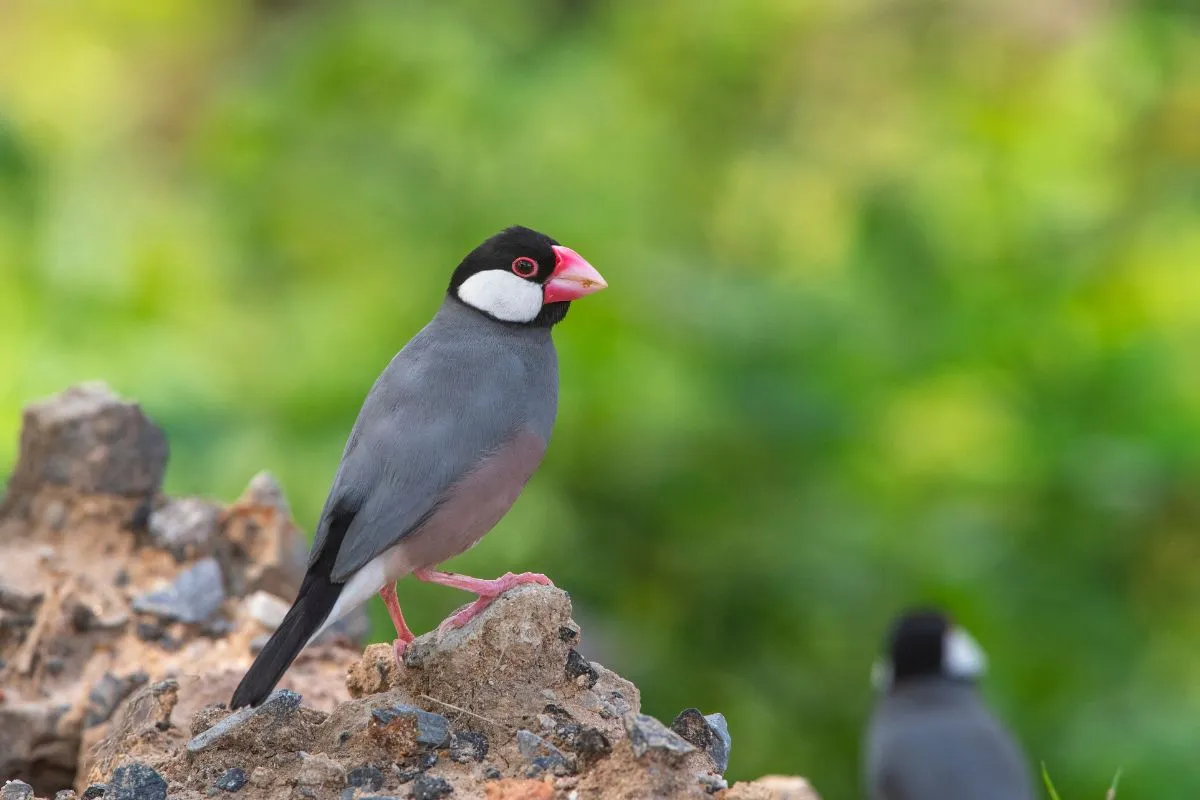
The Java Sparrow is one of the most social birds you’ll ever see. It thrives in flocks and rarely lives alone. In the wild, it moves in groups, eating, flying, and even resting together.
Their communication is constant. The Java Sparrow sound is a soft, rhythmic “chip-chip-chip,” helping the flock stay connected. When one bird calls, others respond, creating a lively, cheerful background wherever they go.
These birds also form strong pairs. Once bonded, a pair tends to stay loyal. They show strong cooperation, from feeding one another to raising their chicks.
Their diet in the wild mainly consists of seeds and grains, especially rice and grass seeds. In captivity, the ideal Java Sparrow food includes a variety of millets, greens, and small insects. This balanced diet supports feather quality and healthy breeding.
Lifespan and Breeding

With proper care, the Java Sparrow lifespan can reach around 7 to 9 years in captivity. Some can live up to 10 years under ideal conditions. In the wild, their life expectancy is often shorter due to predators and environmental stress.
Breeding starts with a nest. A pair will gather grass and twigs to build it, often inside tree cavities, bamboo hollows, or even man-made spaces. The female lays between 4 and 8 eggs, and both parents take turns incubating them for about two weeks.
After hatching, both adults feed the chicks constantly. Within three weeks, the young start to leave the nest and learn to eat on their own. By three months old, they look almost identical to the adults.
This fast and cooperative breeding cycle helps the species recover quickly when conditions are safe and stable.
Conservation Status

The Java Sparrow is now listed as Endangered by the International Union for Conservation of Nature (IUCN). Wild populations are estimated to number fewer than 10,000 mature individuals, and the decline continues.
The main cause is large-scale trapping for the pet trade. During the 20th century, thousands were caught and sold worldwide. Their beauty and calm nature made them popular as cage birds, especially in Asia and Europe. Unfortunately, this trade was unsustainable.
Habitat loss and persecution as crop pests also worsened the situation. Once seen as charming farm companions, they were later trapped or chased away by farmers trying to protect their harvests.
Today, Indonesia’s wildlife laws protect the Java Sparrow, and it’s also listed under CITES Appendix II, meaning international trade is tightly controlled. But enforcement remains a challenge, and illegal trapping still threatens wild populations.
Ex-situ Conservation and Hope

Even though the wild populations are declining, there’s hope. Conservation efforts are underway both within and outside Indonesia.
One key approach is ex-situ conservation, which means protecting and breeding the species in controlled environments such as bird parks, zoos, and breeding centers.
Institutions like Bali Bird Park play an important role in this effort. They maintain healthy populations of Java Sparrows, focusing on keeping them genetically stable and behaviorally healthy. These captive groups serve as a safeguard in case the wild populations collapse.
At these facilities, experts manage breeding carefully to avoid inbreeding and preserve natural traits. Visitors can learn not just about the bird’s beauty but also about the urgency of saving it.
Each chick raised in captivity represents hope. It’s a small but crucial step toward restoring balance and preventing extinction.
If you ever visit Bali, don’t miss the chance to meet this species up close at Bali Bird Park. In this park, Java Sparrows live in environments designed to resemble their natural habitat.
Watch them interact tenderly, staying close and communicating in soft tones. Their calm presence and social behavior make them a favorite among visitors.
Staff at the park are always eager to share the story behind this charming little bird. They explain how the birds are bred responsibly and how each breeding season contributes to global conservation efforts. Some even show how data from these birds is used to improve reintroduction strategies.
What begins as a simple visit turns into a quiet reminder of life’s delicacy and our shared responsibility to protect it. The Java Sparrow deserves more than admiration. It’s a species worthy of our care and the chance to live freely again.